
The track this text was chosen for
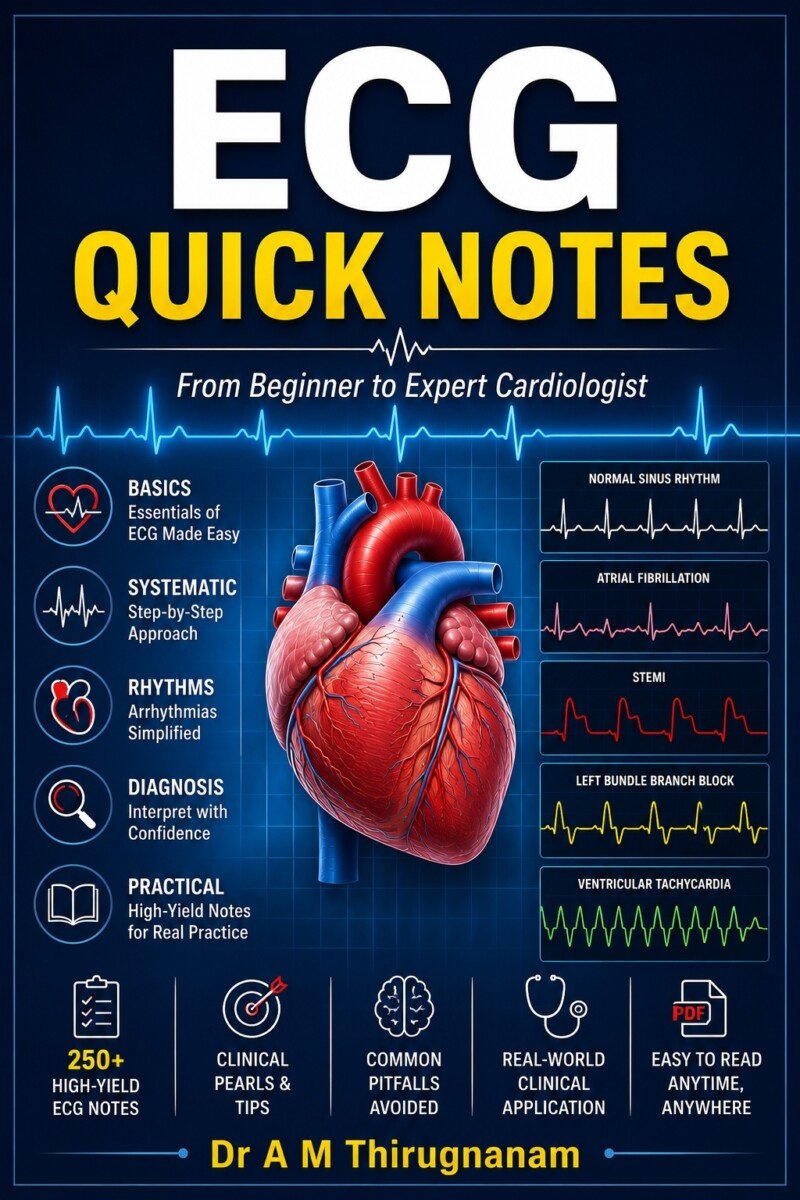
Our Electrocardiography track runs 59 teaching units, and this book has 59 chapters in the same order. That is not coincidence — the track was rebuilt around the book’s sequence after two earlier attempts kept producing the same failure, which was learners arriving at ischaemia before their axis and interval work was secure.
Why sequence is the whole argument
ECG teaching fails in a characteristic way. A learner is shown a striking abnormality early, finds it satisfying, and thereafter reads every tracing looking for the striking thing. The systematic read never becomes automatic, and the subtle occlusion pattern — the one that decides whether the cath lab is activated — goes unnoticed because it was never striking.
The only reliable prevention is a sequence enforced long enough to become habit. Rate, rhythm, axis, intervals, chambers, then ischaemia territory by territory, then conduction, then arrhythmia, then the pattern recognition that only makes sense once all of it is automatic. Every chapter here enforces that order, and every module does the same.
Module map
Modules 1 to 24 correspond to the foundation chapters and are open to all learners including nursing and paramedical staff. Modules 25 onward — complex arrhythmia, Brugada, ARVC, the channelopathies, Wellens and de Winter patterns, the post-arrest tracing — are gated behind the foundation assessment.
Case teaching
Each module pairs a chapter with an unfolding case in which the tracing is released before the history. Learners commit to an interpretation, then receive the clinical context, and frequently discover their reading changes. That discomfort is the point of the exercise.
Enrolment fit
Medical students, interns, emergency and internal medicine residents, coronary care nursing staff, and cardiology trainees taking the advanced modules.
Access
PDF, 399 pages, lifetime access from CardiologyBooks.com.

Reviews
There are no reviews yet.