
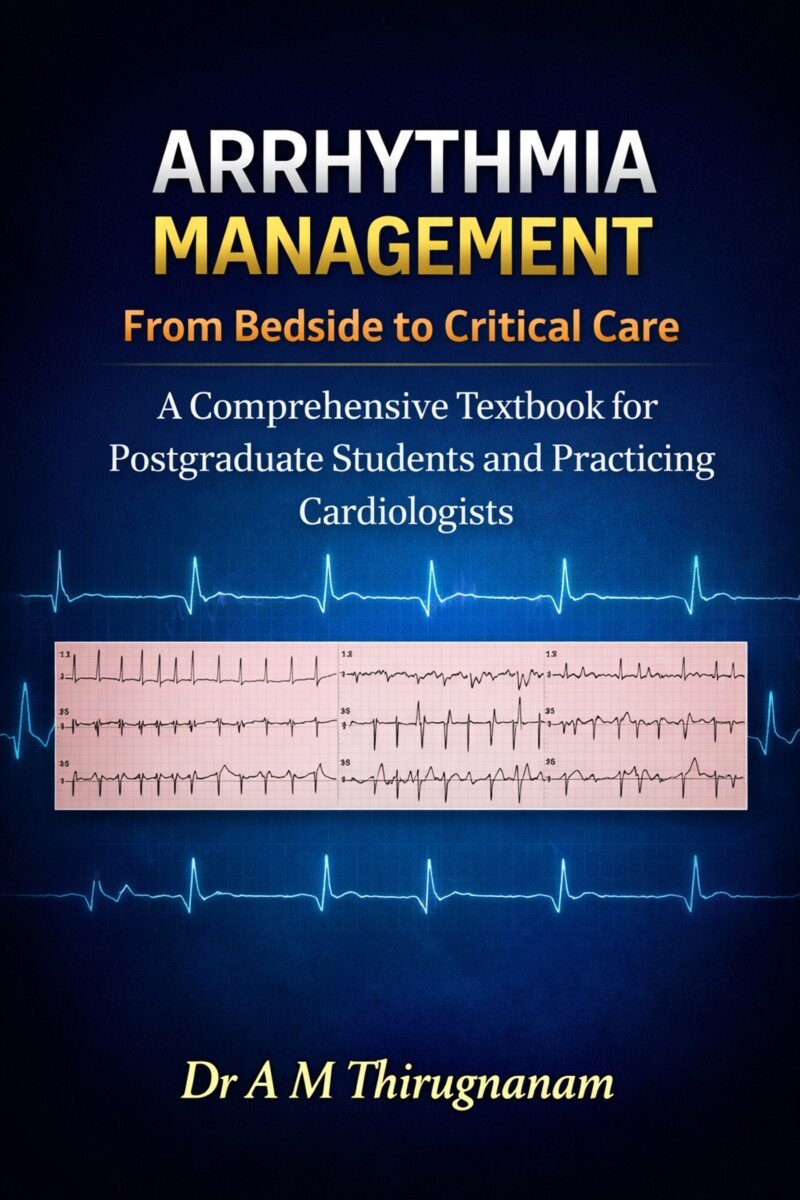
Taught from the triage, not the diagnosis
Conventional arrhythmia teaching starts from named diagnoses and works outward. Our track starts where the clinician starts: a patient, a monitor, and three questions — regular or irregular, narrow or broad, stable or unstable. Everything follows from those, and the diagnosis frequently arrives after the patient is already safe.
This text is organised the same way, which is why it is the set reading rather than one of the several larger alternatives.
Deliberately compact
216 pages. The track aims at general-cardiology competence, not electrophysiological expertise, and a longer text would push learners toward depth they do not need at the cost of the fluency they do.
Module blocks
Recognition and triage first. Acute management organised by that triage. Then the longer-term work: rate against rhythm control and where the evidence has recently moved, anticoagulation weighed with CHA₂DS₂-VASc against HAS-BLED, ablation candidacy, and device selection. Inherited syndromes close the track.
Case format
Rhythm cases release the monitor strip before the history, which reliably produces a split cohort and a useful argument — the strip alone frequently supports two management paths, and the history decides between them.
PDF, lifetime access, at CardiologyBooks.com.


Reviews
There are no reviews yet.