
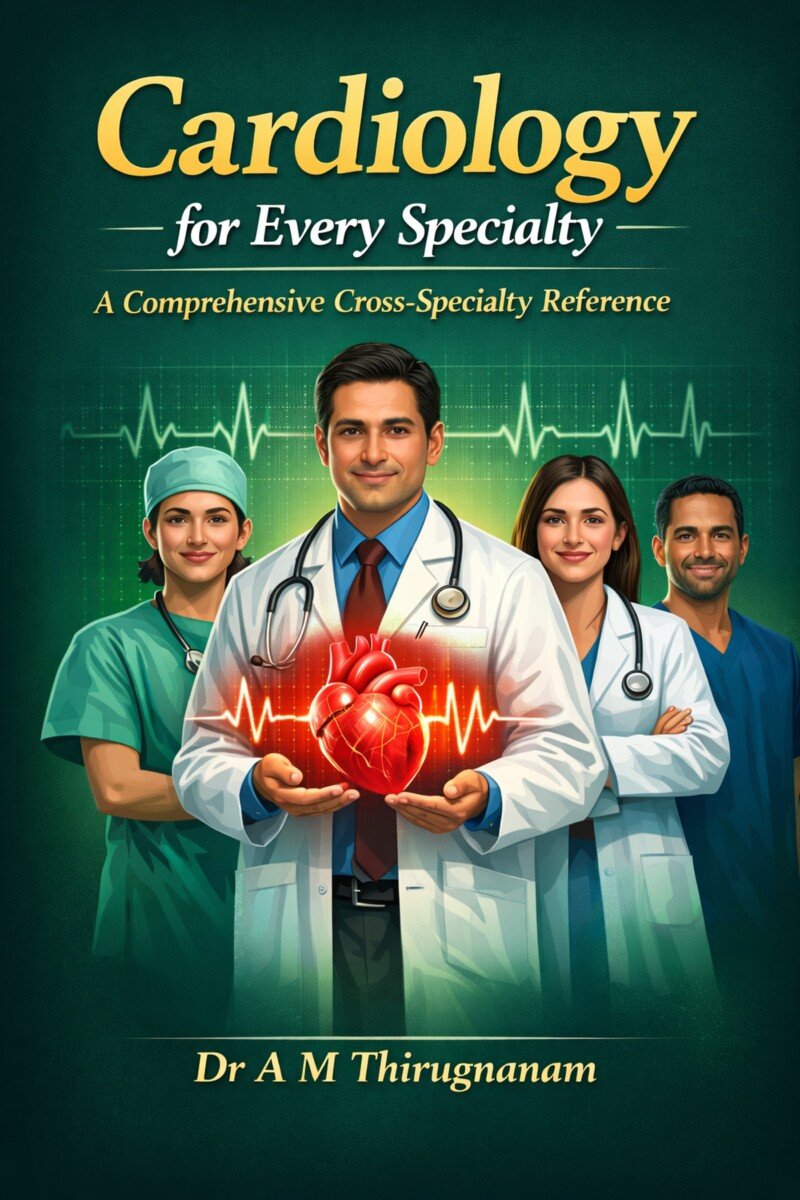
The course this belongs to
Cardiology for Non-Cardiologists is our most-enrolled course and the one with the widest professional mix — anaesthetists, nephrologists, intensivists, endocrinologists, surgeons, family physicians. That mix dictates how the course is built: every session begins from a problem one of those specialties actually owns, and works outward into the cardiology only as far as the decision requires.
This 411-page text is built the same way, which is why it is the set reading rather than a recommended extra.
Teaching structure it supports
Sessions are case-led and specialty-tagged. A single teaching hour might run the same patient — severe aortic stenosis, needing a hip replacement, on an antiplatelet — past the anaesthetist, the surgeon and the physician, asking each what they would do and where their responsibility ends. The chapters here are written to be read from any of those three positions.
Module and chapter alignment
Perioperative assessment and antiplatelet interruption support Modules 2 and 3. Heart failure with renal impairment supports Module 5. Arrhythmia recognition for the non-specialist, including explicit escalation thresholds, supports Module 6. Chest pain triage, valve disease in non-cardiac surgery, cardio-oncology, and the cardiac effects of endocrine and autoimmune disease follow across the remaining modules.
The antithrombotic sections use the terminology the course uses — DAPT, TAT, DAT, HAS-BLED — and take their duration guidance from TWILIGHT, AUGUSTUS and PIONEER AF-PCI, which are the trials discussed in the Module 3 seminar.
Who enrols
Practising specialists outside cardiology, senior residents in any medical or surgical discipline, and final-year students preparing for general medical practice.
Access
PDF, lifetime access, retained after course completion. Purchased through CardiologyBooks.com.
Reviews
There are no reviews yet.