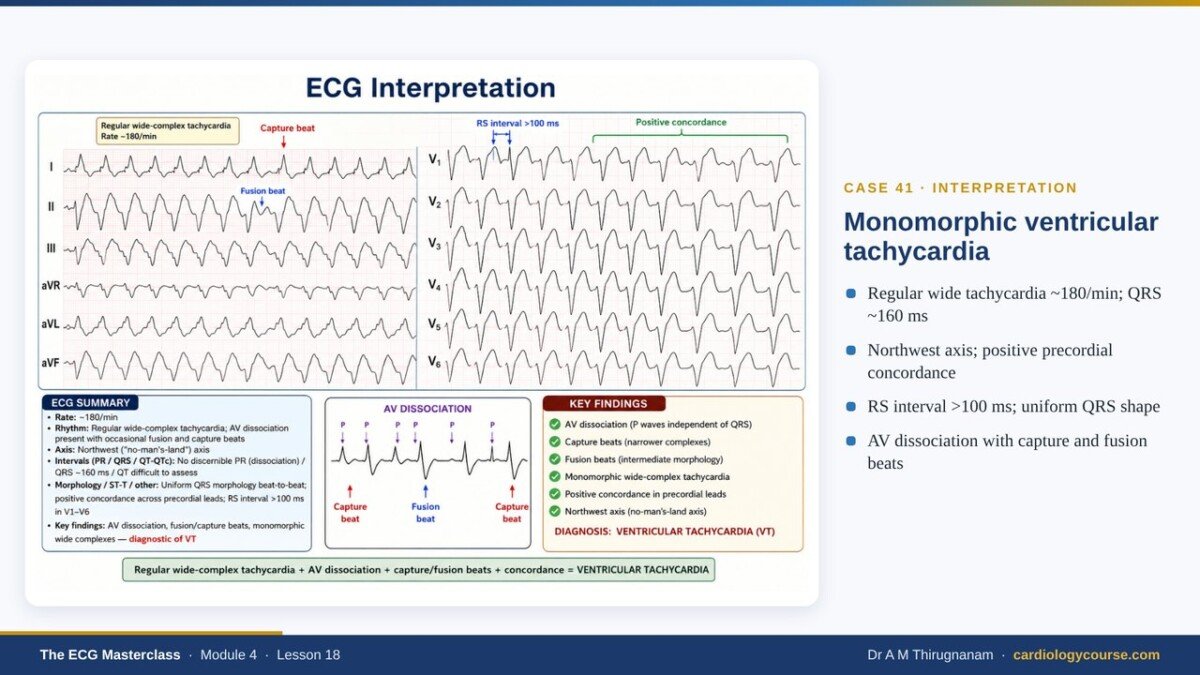
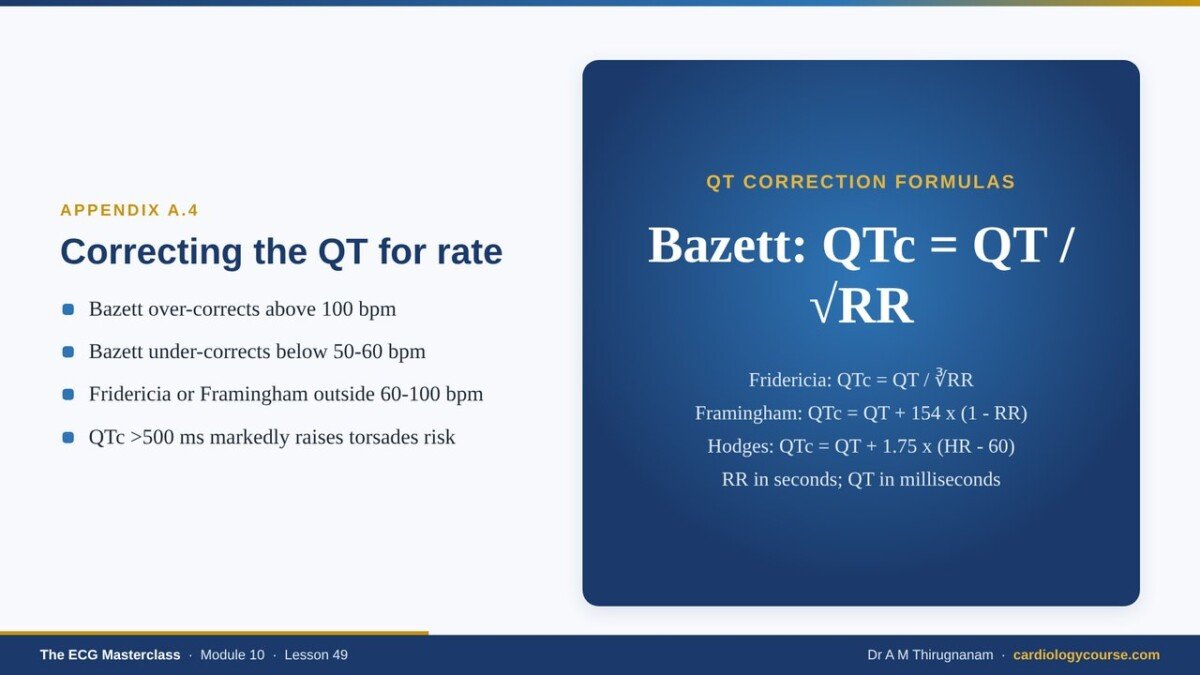
Learn ECG interpretation case by case, the way it is read at the bedside
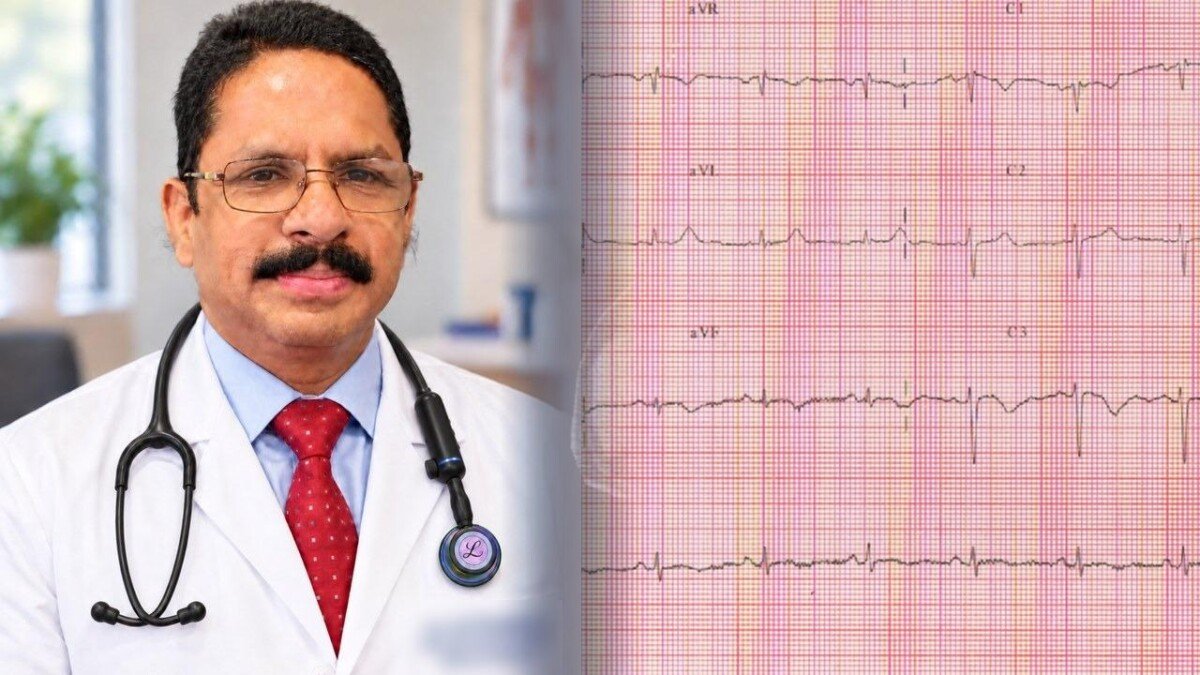
The ECG Masterclass is a seven-hour online ECG course for doctors. It turns the book The ECG Masterclass: 140 Annotated Cases in Electrocardiography by Dr A M Thirugnanam, Senior Interventional Cardiologist, Researcher, Teacher, Author and Proctor, into 51 narrated video lessons that take you from the cellular basis of the 12-lead ECG to confident, systematic interpretation of the hardest tracings.
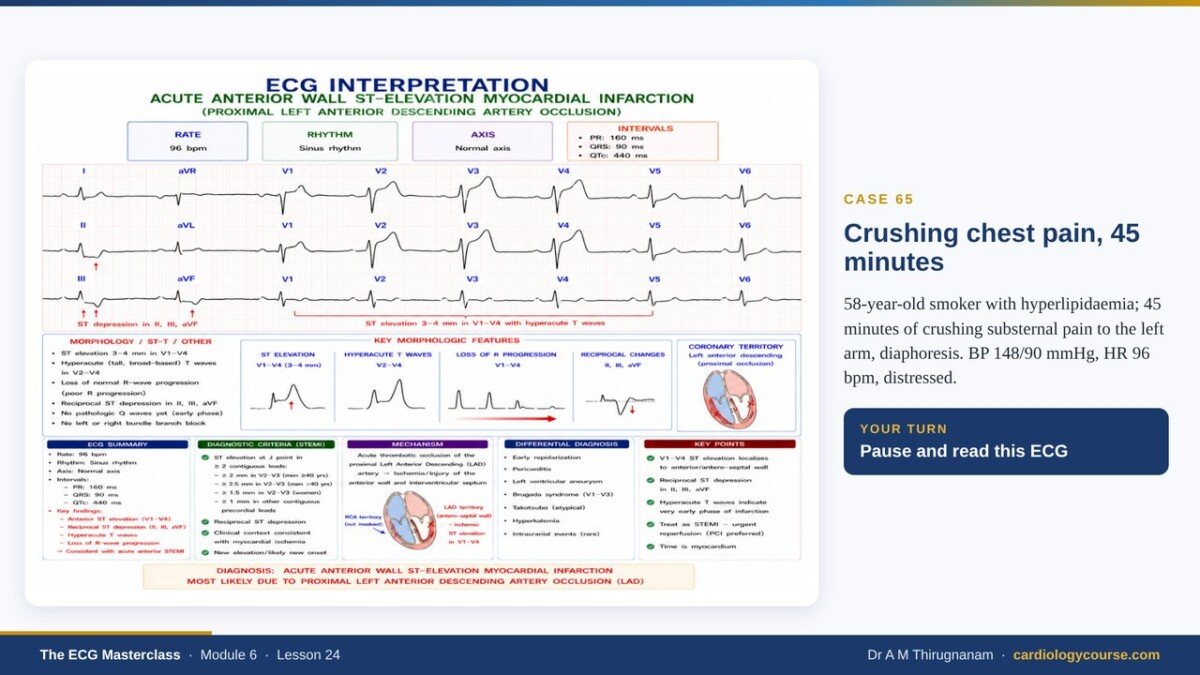
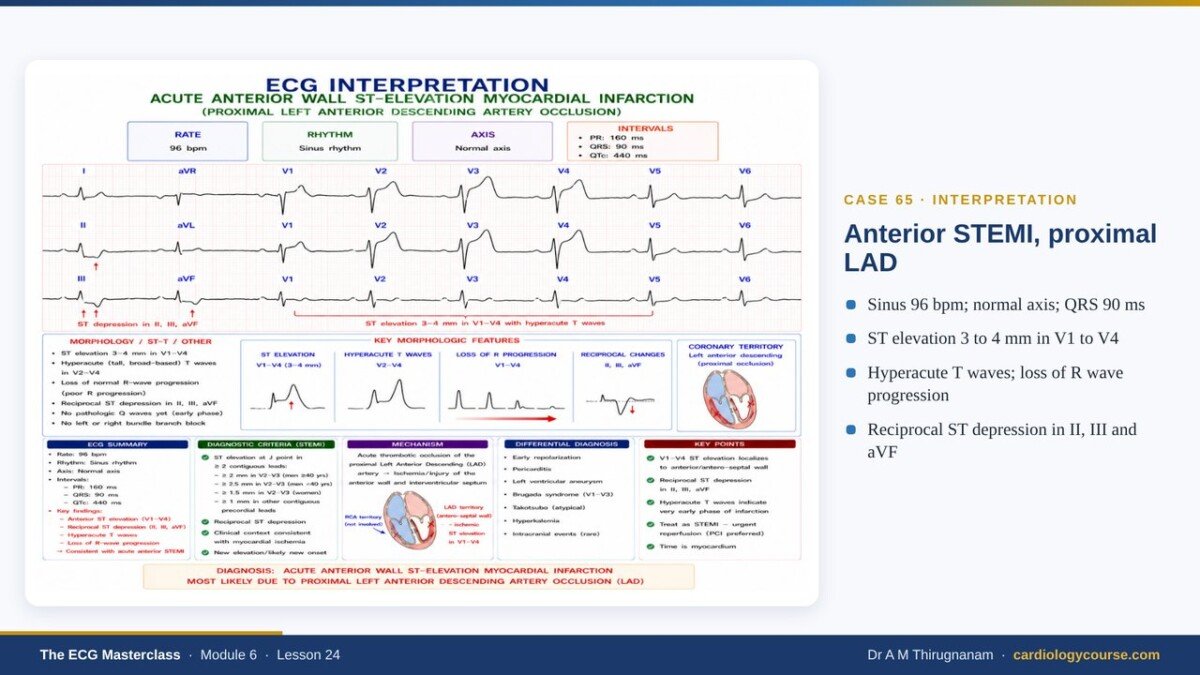
Every case follows the same rhythm: you meet the patient and the ECG, pause and read it yourself, then walk through rate, rhythm, axis, intervals and morphology to the diagnosis, followed by the differential, guideline-based management and the teaching pearl.
Who this ECG interpretation course is for
- Postgraduates in medicine, cardiology, anaesthesia, emergency medicine and critical care
- Physicians, intensivists and emergency doctors who read ECGs every day
- Cardiology fellows and residents
- Doctors preparing for cardiology and medicine board examinations (MD, DNB, DM, MRCP, NEET SS)
What you will learn
- Read any 12-lead ECG with a fast, reproducible eight-step system
- Explain each wave from cardiac electrophysiology and the action potential
- Recognise normal variants, lead misplacement, dextrocardia and artefact
- Diagnose atrial fibrillation, flutter, SVT, AVNRT, AVRT and WPW, including pre-excited AF
- Tell ventricular tachycardia from SVT with aberrancy and manage torsades de pointes
- Grade first-degree, Mobitz I, Mobitz II and complete heart block, and bundle branch and fascicular blocks
- Localise STEMI by territory, including posterior and right ventricular infarction, and recognise STEMI equivalents such as Wellens, de Winter and aVR patterns
- Identify LVH, RVH, hyperkalaemia, hypokalaemia, hypercalcaemia, digoxin and drug effects, pacemaker ECGs and CRT
- Recognise Brugada, long QT, short QT, ARVC, pericarditis, tamponade and pulmonary embolism
- Turn each ECG into a guideline-based management decision
Course curriculum: 10 modules, 51 video lessons
Module 1: Foundations of the 12-Lead ECG
- Lesson 1: The Electrical Heart
- Lesson 2: From Conduction to Waveform
- Lesson 3: The 12-Lead ECG
- Lesson 4: Axis, Vectors and Calibration
- Lesson 5: A Systematic Reading Sequence
Module 2: Normal Variants and the Sinus Node
- Lesson 6: The Normal ECG and Benign Variants
- Lesson 7: Sinus Tachycardia, Juvenile T, Low Voltage
- Lesson 8: Dextrocardia, Lead Reversal, Poor R Waves
- Lesson 9: Sinus Pause, SA Exit Block and Sick Sinus
- Lesson 10: Wandering Pacemaker, IST and Ectopic Rhythm
Module 3: Atrial and Supraventricular Arrhythmias
- Lesson 11: Atrial Fibrillation and Typical Flutter
- Lesson 12: Flutter, MAT and Focal Atrial Tachycardia
- Lesson 13: Premature Atrial Beats and Pre-excited AF
- Lesson 14: AVNRT, AVRT and the WPW Pattern
- Lesson 15: Short PR, Junctional Escape and Acceleration
- Lesson 16: Junctional Tachycardia, PSVT and PJRT
Module 4: Ventricular Arrhythmias
- Lesson 17: PVCs, Bigeminy and Non-sustained VT
- Lesson 18: VT, Torsades and Ventricular Fibrillation
- Lesson 19: AIVR, Wide-Complex and Idiopathic VT
Module 5: AV Block and Intraventricular Conduction
- Lesson 20: First-Degree, Mobitz I, Mobitz II, 2:1 Block
- Lesson 21: High-Grade, Complete Block and AV Dissociation
- Lesson 22: Bundle Branch and Fascicular Blocks
- Lesson 23: Multifascicular, IVCD and Rate-Related Block
Module 6: Acute STEMI by Territory
- Lesson 24: Anterior, Anteroseptal and Inferior STEMI
- Lesson 25: RV, Posterior and Lateral STEMI
- Lesson 26: Flag Sign, aVR, de Winter and Wellens
- Lesson 27: Hyperacute T, LBBB, Reperfusion and RV MI
Module 7: Ischaemia, Infarction and Hypertrophy
- Lesson 28: NSTEMI, Demand Ischemia and Old Anterior MI
- Lesson 29: Old Inferior MI, LV Aneurysm, Spasm, Takotsubo
- Lesson 30: LVH, RVH and Atrial Enlargement
- Lesson 31: BVH, Biatrial Enlargement, HCM and Athletes
Module 8: Electrolytes, Drugs and Devices
- Lesson 32: Hyperkalemia, Hypokalemia and Hypercalcemia
- Lesson 33: Hypocalcemia, Magnesium, Hypothermia and CKD
- Lesson 34: Digoxin Effect, Digoxin Toxicity and TCAs
- Lesson 35: Drug QT, Amiodarone and Nodal-Blocker Overdose
- Lesson 36: Dual-Chamber, Atrial and Ventricular Pacing
- Lesson 37: Capture, Sensing and CRT Pacing
Module 9: Channelopathies, Systemic Disease and Challenging Cases
- Lesson 38: Brugada, Long QT and Short QT
- Lesson 39: ARVC, CPVT, Apical HCM and J Waves
- Lesson 40: Pericarditis, Tamponade and PE
- Lesson 41: Cor Pulmonale, Myocarditis and COPD
- Lesson 42: Newborn, ASD, Ebstein and AV Septal Defect
- Lesson 43: Alternans, Artefact and Hyperventilation
- Lesson 44: Athlete's ECG, Endless Loop, Intermittent WPW
Module 10: Arrhythmia Management and the ECG Toolkit
- Lesson 45: Arrhythmias: Mechanisms and Bradyarrhythmias
- Lesson 46: Narrow-Complex Tachycardia and AF Management
- Lesson 47: Wide-Complex Tachycardia and Inherited Syndromes
- Lesson 48: Special Situations, Arrest Rhythms and Definitive Therapy
- Lesson 49: ECG Calculations and Formulas
- Lesson 50: Drugs, Conduction and the ECG
- Lesson 51: Treating ECG Emergencies
Final Assessment and Certificate
- 50-question final certifying examination drawn from 100 questions (pass mark 70%)
- Academy of Elite Doctors certificate of completion, signed by Dr A M Thirugnanam
What is included
- 51 HD video lessons, 7 hours 27 minutes in total
- 140 annotated ECG cases
- A downloadable PDF handout for every module
- Ten module quizzes with 306 board-style MCQs and explanations
- A 50-question final examination
- Certificate of completion from the Academy of Elite Doctors, verifiable online
- Lifetime access on any device
About your instructor
Dr A M Thirugnanam is a Senior Interventional Cardiologist, Researcher, Teacher, Author and Proctor in Hyderabad, India. He is the founder of the Academy of Elite Doctors and the author of many cardiology textbooks, including The ECG Masterclass and ECG Quick Notes.
Frequently asked questions
Who is this ECG course for?
Postgraduates in medicine, cardiology, anaesthesia, emergency medicine and critical care, physicians, intensivists and emergency doctors who read ECGs every day, cardiology fellows and residents, and doctors preparing for cardiology and medicine board examinations. No previous ECG specialisation is needed.
How long is the course and how long do I have access?
The course has 51 video lessons, 7 hours 27 minutes in total, organised into ten modules. You get lifetime access and can learn at your own pace on any device.
Is the course taught on real ECG cases?
Yes. It is built on 140 annotated 12-lead ECG cases from the book The ECG Masterclass. For each case you see the patient and the tracing, read it yourself, then follow a systematic interpretation, the differential diagnosis and the management.
Do I get a certificate?
Yes. When you pass the 50-question final examination (pass mark 70%, three attempts), you can download a certificate of completion from the Academy of Elite Doctors with a unique ID that can be verified online. It is a certificate of course completion, not a CME or university credit.
What is included besides the videos?
A downloadable PDF handout for every module with each case's ECG, interpretation and management, ten module quizzes with 306 board-style questions and explanations, and a final certifying examination.
How do I pay?
The course costs ₹12,600, paid once through secure Razorpay checkout by credit card, debit card or net banking. Create an account at checkout so that the course appears in your dashboard immediately after payment.
View the full course page and lesson list · Also see Echocardiography Basics for Doctors
Use of AI: the clinical content, scripts and ECG figures are the author’s own. Narration uses an AI text-to-speech model of the author’s own voice. This course is for medical education and does not replace supervised clinical training.
Reviews
There are no reviews yet.