
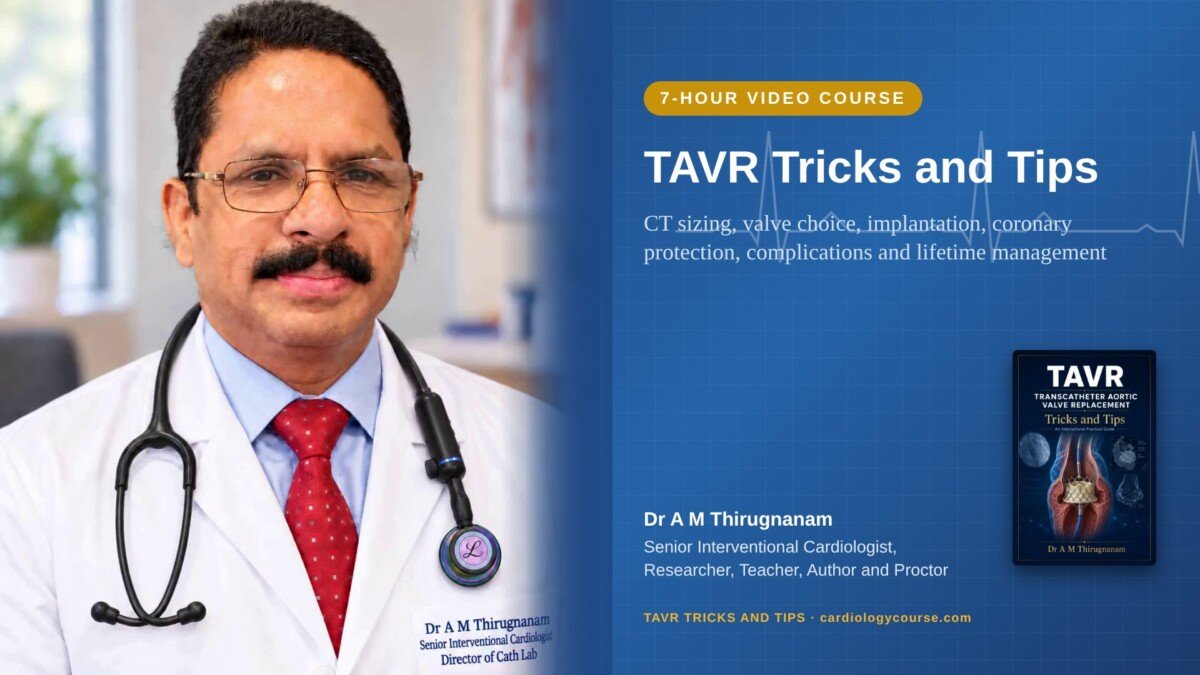
About Course
Every number, projection and bailout you need at the TAVR table
TAVR Tricks and Tips is a seven-hour narrated video course by Dr A M Thirugnanam, Senior Interventional Cardiologist, Researcher, Teacher, Author and Proctor. It takes structural and interventional cardiologists, fellows, imaging specialists and heart team members through the whole transcatheter aortic valve pathway, from patient selection and CT sizing to deployment, complications and lifetime management.
The course is built on the textbook TAVR Tricks and Tips: Practical International Guide and uses all 159 of its figures, animated on screen. It is current to the 2025 ESC/EACTS valvular heart disease guideline, the 2020 ACC/AHA guideline and VARC-3, and draws on the landmark trials: PARTNER, Evolut Low Risk, NOTION, NOTION-3, DEDICATE, SMART, EARLY TAVR, POPular TAVI, GALILEO, ATLANTIS, ENVISAGE-TAVI AF, PROTECTED TAVR and more.
What is inside
- 32 HD video lectures in eight modules (about seven hours), with English subtitles
- Severity grading, low-gradient dilemmas, amyloid and frailty
- TTE, 3D TEE and MDCT step by step: annulus, coronary heights, membranous septum, coplanar angles and access
- Heart team decisions, risk beyond the scores and choosing between balloon-expandable, self-expanding and mechanically expanded valves
- Transfemoral and alternative access, pacing, crossing, the stiff wire, depth control and deployment tricks for every platform
- Bicuspid valves, horizontal aorta, heavy calcium, small and large annuli, valve-in-valve and pure AR
- Predicting coronary obstruction, chimney stenting, BASILICA and commissural alignment
- Large-bore closure, the bleeding access site, annular rupture, embolisation, tamponade and the bailout tray
- Conduction disturbance and pacing, antithrombotic therapy, leaflet thrombosis, durability and redo TAVR
- Lifetime management of younger patients and building a TAVR programme
- Eight module PDF handouts, 96 module quiz questions and a 64-question final examination
- Academy of Elite Doctors certificate of completion
Curriculum
- Module 1: The Aortic Valve and the Right Patient — The Aortic Root Reimagined; Bicuspid Valves, Natural History and Two Decades of Evidence; Grading Severity: Thresholds and Flow-Gradient Phenotypes; Moderate AS, Amyloid and the Patient Who Should Not Be Treated
- Module 2: Imaging for TAVR: Echo and MDCT — The Echo Dataset and Getting the Numbers Right; Echo on the Table: 3D TEE, Leaks and Complications; MDCT Sizing Step by Step; MDCT for Depth, Projections and Access
- Module 3: Heart Team Decisions and Valve Choice — Risk Beyond the Scores; Running the Heart Team; Balloon-Expandable, Self-Expanding and Mechanical Platforms; Haemodynamics, Durability and Choosing in the Real World
- Module 4: Access and Step-by-Step Implantation — Transfemoral First: Puncture, Landmarks and Safety Wires; When Femoral Is Not an Option; Setting Up the Implant: Pacing, Crossing and the Stiff Wire; Deployment Tricks for Every Platform
- Module 5: Difficult Anatomy and Coronary Protection — Bicuspid, Horizontal Aorta, Calcium and Small Annuli; Large Annuli, Pure AR, Valve-in-Valve and MAC; Predicting Coronary Obstruction; Chimney, BASILICA and Commissural Alignment
- Module 6: Closure, Complications and Bailout — Closing the Large-Bore Access Site; The Bleeding Access Site: Bailout and Reporting; The Hypotensive Patient: Rupture, Embolisation and Tamponade; Collapse, Arrhythmia and the Bailout Tray
- Module 7: Conduction, Antithrombotics and Life After TAVR — Conduction After TAVR: Anatomy, Mechanisms and Predictors; New LBBB, Temporary Wires and Permanent Pacing; Antithrombotic Therapy and Leaflet Thrombosis; Endocarditis, Follow-Up and Valve-in-Valve
- Module 8: Lifetime Management and Building a Programme — TAVR in Younger and Low-Risk Patients; Lifetime Plans for the Young Patient; Building the TAVR Team and Pathway; Quality, Registries and Sustainability
Educational content for healthcare professionals. Always follow the device instructions for use, current guidelines and your local policy.
Course Content
Module 1: The Aortic Valve and the Right Patient
Lecture 1: The Aortic Root Reimagined
14:58Lecture 2: Bicuspid Valves, Natural History and Two Decades of Evidence
15:12Lecture 3: Grading Severity: Thresholds and Flow-Gradient Phenotypes
15:38Lecture 4: Moderate AS, Amyloid and the Patient Who Should Not Be Treated
15:18Module 1 Quiz: The Aortic Valve and the Right Patient
Module 2: Imaging for TAVR: Echo and MDCT
Module 3: Heart Team Decisions and Valve Choice
Module 4: Access and Step-by-Step Implantation
Module 5: Difficult Anatomy and Coronary Protection
Module 6: Closure, Complications and Bailout
Module 7: Conduction, Antithrombotics and Life After TAVR
Module 8: Lifetime Management and Building a Programme
Final Examination and Certificate
Student Ratings & Reviews
